1. Scope of CEA Regulations 2010
The Central Electricity Authority (Measures relating to Safety and Electric Supply) Regulations, 2010 forms the statutory backbone of electrical safety across India. Under these regulations, every commercial establishment, hospital, IT park, and industrial factory operating electrical installations must comply with strict physical clearances, protective relay settings, and insulation tolerances.
Industrial fires caused by electrical short circuits represent over 65% of industrial accidents in India. Routine electrical safety audits are both a statutory obligation and a critical operational safeguard.
---
2. Key Mandatory Safety Clauses
During an electrical safety audit, our certified safety auditors systematically evaluate compliance against the following core statutory clauses:
---
3. IS 3043 Earthing & Soil Resistivity
Proper earthing provides an instantaneous path for fault current, safeguarding personnel against touch and step voltages. All earthing systems must adhere to IS 3043:2018:
Earthing Resistance Thresholds:
Testing Methodology:
Our engineers utilize calibrated four-terminal digital Earth Resistance testers using the Fall-of-Potential method, plotting resistance curves against electrode distance to detect soil stratification.---
4. Arc Flash Hazards (IEEE 1584 & NFPA 70E)
An arc flash generates temperatures exceeding 19,000°C—hotter than the surface of the sun—causing catastrophic pressure waves and fatal burns.
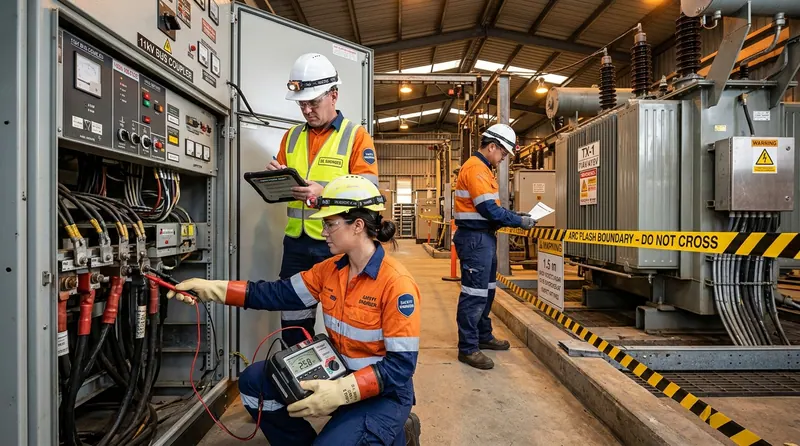
Our safety audits include arc flash hazard calculations: 1. Short Circuit Modeling: Fault current determination across busbars using ETAP / computer simulation. 2. Clearing Time Verification: Verification of breaker trip curves and upstream relay coordination. 3. Incident Energy Calculation (cal/cm²): Determining exact boundary distances and specifying correct Personal Protective Equipment (PPE Level 1 to 4) labels on all switchboards.
---
5. Top 5 Most Common Safety Violations Spotted on Sites
1. Missing or Bypassed Relay Interlocks: Breaker trip units wired around because of nuisance tripping rather than fixing the underlying leakage. 2. Sub-standard Insulation Mats: Using generic decorative rubber mats instead of tested IS 15652 Class-A/B/C electrical safety grade mats. 3. Improper Neutral-Earth Bonding: Neutral looped back into body ground at downstream distribution boards, introducing dangerous neutral-to-earth voltages. 4. Blocked Switchgear Aisles: Storage boxes and spare equipment stacked within the mandatory 1.0 to 1.25m front clearance zone. 5. Deteriorated Earth Pit Electrode Rods: Corroded pipe/plate electrodes with dry backfill soil yielding earth resistance values exceeding 25 Ohms.
Ensure your plant is protected against legal liabilities and hazardous downtime. Book an official electrical safety audit with Athul Energy's senior safety engineers today.