Govt. accreditedEMC Kerala / BEE / GEDAEnergy · Safety · Sustainabilitysince 2008
+91 73561 11990info@athulenergy.com
Athul Energy Consultants
Home
About
Company Profile & StoryWho we are, BEE & EMC empanelments, and 15+ years of audit history since 2008.Our Engineering TeamBEE Accredited Energy Auditors, CEA Safety Inspectors, FLIR Thermographers & Green specialists.
Services
Energy AuditsDetailed electrical, thermal, PAT M&V and mandatory BEE/EMC statutory assessments.Safety AuditsCEA regulation compliance, arc flash analysis, fire safety and IS 14489 hazard reviews.Thermography & SurveysFLIR Level-II thermal scanning, ultrasonic flow testing and IS 3043 earthing studies.Compliance & NAACGRIHA green building audits, NAAC criteria 7, NABH hospital safety and ISO 50001.Technical TrainingBEE exam coaching, industrial electrical safety, LOTO protocols and engineer workshops.All 30+ Services HubExplore complete directory with live keyword search, standards and instrument specs.
30+ Disciplines · BEE Accredited & EMC EmpanelledBrowse full directory
GalleryBlogContact
Request an audit
Home
GalleryBlogContact
Call usRequest an audit
Athul Energy Consultants

BEE accredited energy audit and electrical safety consultants serving industrial, commercial and institutional sites across Kerala since 2008.

BEE AEA-0275EMC KeralaGEDAMEDA
+91 73561 11990Email us

Company

  • About us
  • Engineering team
  • Downloads
  • Gallery
  • News & events
  • Contact

Services

  • Energy Audits
  • Safety Audits
  • Thermography & Surveys
  • Compliance & NAAC
  • Technical Training
  • All 30 services

Head office

Capital Legend Building,
Korappath Lane, Thrissur North,
Kerala 680020

+91 73561 11990

info@athulenergy.com

© 2026 Athul Energy Consultants Pvt. Ltd. All rights reserved.

BEE accredited · Est. 2008Request an audit
HomeBlogPower Quality & HarmonicsPower Quality Harmonics & IEEE 519: Sizing Active Harmonic Filters to Avoid Utility Penalties
Power Quality & HarmonicsSeptember 28, 2026•7 min read

Power Quality Harmonics & IEEE 519: Sizing Active Harmonic Filters to Avoid Utility Penalties

Understanding Total Harmonic Distortion (THD-V and THD-I), neutral overheating, capacitor bank resonance, and how to size Active Harmonic Filters (AHF) for clean power.

SP
Sreejith P. MenonLead Energy Auditor & Electrical Design Specialist
BEE EA-1842
Power Quality Harmonics & IEEE 519: Sizing Active Harmonic Filters to Avoid Utility Penalties
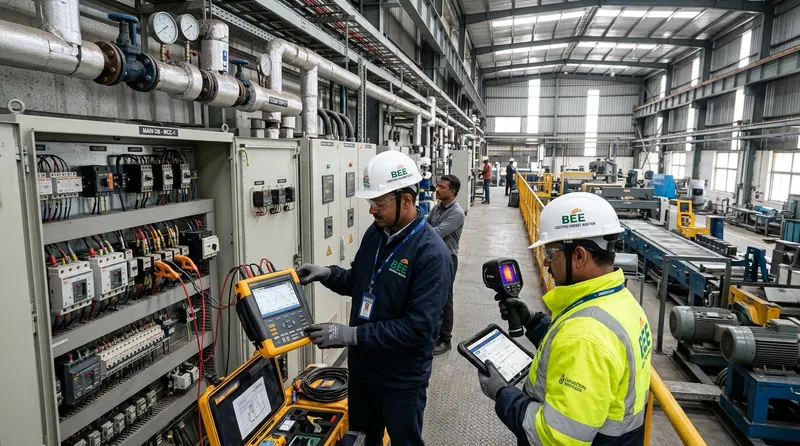
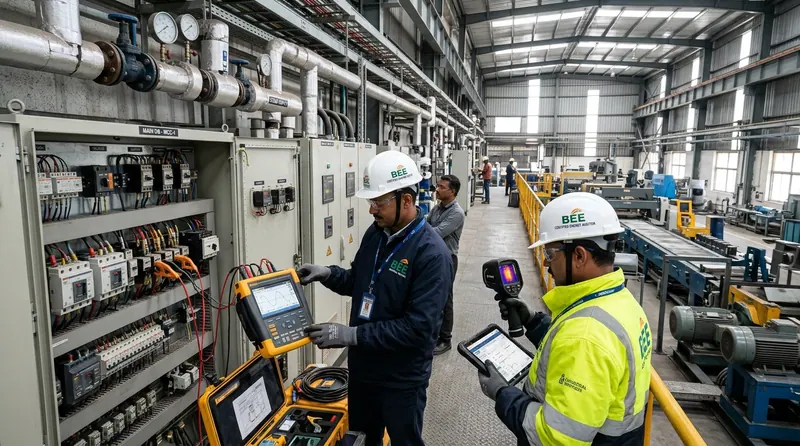
Field Study Dossier · Athul Energy ConsultantsNABL Calibrated Instrumentation
Key Statutory Takeaways for Plant Managers
  • Mandatory compliance intervals must be adhered to avoid Section 26 fines under the Energy Conservation Act 2001.
  • All baseline SEC and electrical safety reports require direct sign-off by a BEE Accredited Energy Auditor.
  • Third-party verified NABL instrument calibration is legally required for Form 1 and Form A/B verification.

1. What are Harmonics and Why Do They Occur?

In a balanced, linear AC power network, current and voltage maintain a clean 50 Hz sinusoidal waveform. However, modern industrial facilities rely heavily on non-linear electrical loads:

  • Variable Frequency Drives (VFDs) and DC drives.
  • Uninterruptible Power Supplies (UPS) and rectifiers.
  • Induction melting furnaces and welding equipment.
  • LED driver electronics and server power supplies.
  • These devices draw current in abrupt pulses rather than smooth waves, generating harmonic frequencies that are integer multiples of the fundamental 50 Hz frequency (3rd = 150 Hz, 5th = 250 Hz, 7th = 350 Hz, 11th = 550 Hz).

    ---

    2. The Hidden Cost of High THD in Plants

    Excessive harmonic distortion introduces severe operational and financial hazards: 1. Transformer Overheating & K-Factor Derating: Eddy current losses in transformer iron cores scale with the square of frequency ($f^2$), causing transformers to overheat even when running at 70% rated kVA load. 2. Neutral Conductor Overheating: Triplen harmonics (3rd, 9th, 15th) do not cancel out at the neutral point; they add arithmetically, causing neutral currents to exceed phase currents and burning neutral cables. 3. Capacitor Bank Explosions: Shunt power factor capacitors offer low impedance at high frequencies ($X_c = 1 / 2pi fC$), drawing harmonic currents that cause bulging, insulation failure, and catastrophic resonance. 4. Nuisance Breaker Tripping: Electronic trip units miscalculate true RMS values, causing unexpected factory blackouts.

    ---

    3. IEEE 519-2022 Statutory Voltage & Current Limits

    Under IEEE 519-2022, the maximum allowable Total Harmonic Distortion at the Point of Common Coupling (PCC) depends on the system voltage and the plant's Short Circuit Ratio ($I_{sc} / I_L$):

    Voltage Harmonic Limits at PCC:

  • Bus Voltage $le$ 1.0 kV: Maximum Individual Harmonic = 5.0%, Total Voltage Distortion ($THD_V$) = 8.0%.
  • Bus Voltage 1.0 kV to 69 kV: Maximum Individual Harmonic = 3.0%, Total Voltage Distortion ($THD_V$) = 5.0%.
  • State electricity regulatory commissions (SERCs) across India have begun enforcing strict penalties or disconnection notices for industrial facilities exceeding prescribed harmonic distortion limits at the utility metering boundary.

    ---

    4. Passive Detuned vs. Active Harmonic Filters

  • Passive Detuned Reactors (7% or 14%): Installed in series with power factor capacitor banks to shift the resonant frequency below the 5th harmonic (to 189 Hz or 134 Hz). They protect the capacitors from resonance but do not actively cancel harmonic currents.
  • Active Harmonic Filters (AHF): High-speed IGBT-based power electronic systems that monitor line current in real time, generate an exact opposite phase-shifted canceling current, and inject it into the busbar within milliseconds.
  • ---

    5. Sizing Active Harmonic Filters Correctly

    To size an AHF properly without overpaying or leaving harmonic currents unmitigated: 1. Conduct a continuous 24-to-72 hour Class-A power quality log across full production cycles. 2. Determine the fundamental load current ($I_1$) and the 5th, 7th, 11th, and 13th harmonic currents ($I_h$). 3. Calculate the required harmonic compensation current: $$I_{AHF} = sqrt{I_5^2 + I_7^2 + I_{11}^2 + I_{13}^2} imes 1.25 ext{ (Safety Margin)}$$ 4. Ensure the selected unit supports simultaneous dynamic reactive power (kVAr) compensation and phase unbalance correction.

    Athul Energy provides complete Class-A power quality logging and third-party verified AHF sizing reports.
    Related Engineering Tags:
    #Power Quality#Harmonics#IEEE 519#Active Harmonic Filter#THD
    SP
    Article Author & Technical Auditor

    Sreejith P. Menon

    Lead Energy Auditor & Electrical Design Specialist

    Power systems and harmonics engineer specializing in Class-A power quality logging, IEEE 519 compliance verification, and filter sizing for manufacturing plants.

    Related Technical Guides

    View all insights →
    Complete Guide to Mandatory BEE Energy Audits for Designated Consumers (PAT Scheme)
    BEE Energy Audits
    8 min read
    BEE Energy Audits
    Oct 28, 2026

    Complete Guide to Mandatory BEE Energy Audits for Designated Consumers (PAT Scheme)

    A technical walkthrough for plant managers and electrical heads on compliance under the Energy Conservation Act 2001, Form 1 filings, SEC baseline benchmarking, and ESCerts trading.

    Santhosh A.•Oct 28
    SA
    Santhosh A.Lead BEE Accredited Energy Auditor (AEA-0275)
    Read Guide
    Table of Contents
    1. What are Harmonics and Why Do They Occur?2. The Hidden Cost of High THD in Plants3. IEEE 519-2022 Statutory Voltage & Current Limits4. Passive Detuned vs. Active Harmonic Filters5. Sizing Active Harmonic Filters Correctly
    Empanelled Firm

    Schedule a Facility Audit

    Need assistance with BEE statutory audits, electrical safety sign-offs, or power quality mitigation?

    Request Audit Scoping+91 73561 11990
    NDA Assured:Plant single-line diagrams and utility bills are handled strictly under non-disclosure agreements.